Why Madasgascar? — The unlikely start to a project
 March 13, 2026
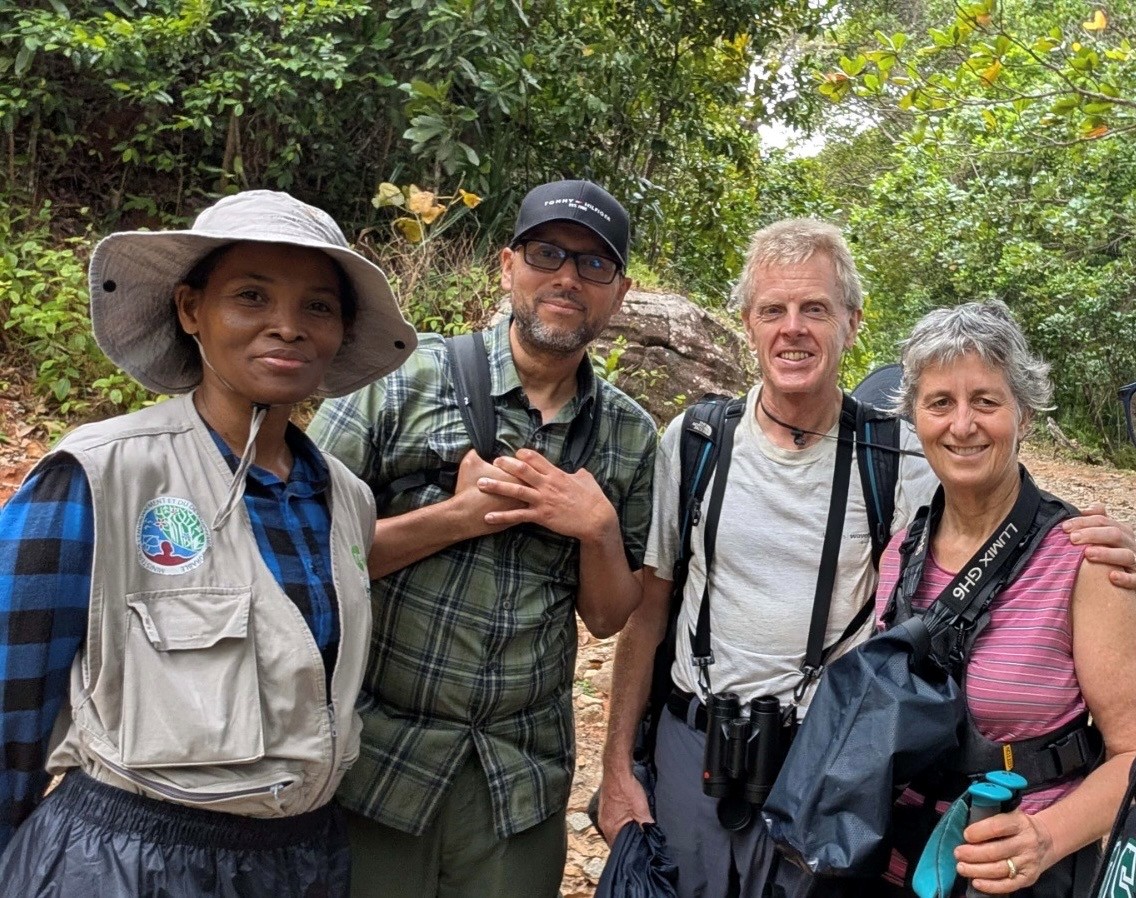
Photo above, from left to right: Noro Razafindrakoto, Carlos R. García,
Kevin Tate, Claudia Morawetz. Photo: IMPACT Madagascar
“Wait, what? You have a conservation project in Madagascar? Why Madagascar?”
by Kevin Tate and Claudia Morawetz
We get asked these questions a lot. Inevitably, these questions are followed by statements learned from books, television, social media, and friends about how difficult Madagascar is, from poverty to corruption to poor governance and an ecological disaster being compounded by a rapidly expanding population.
Sadly, all those things are true. It is a complicated place. In aggregate, it’s safe to say that there is no other country like Madagascar, in all the widely recognized bad ways but also good ways. Madagascar has the largest percentage of endemic species of any country in the world: around 90% of all its plant and animal species occur nowhere else on earth. But it’s more than that.
Madagascar is an island biosphere that has evolved in isolation over tens of millions of years in unique ways. Approach the island with curiosity, and everywhere you look you find unexpected surprises. This results from taking an isolated mini-continent with mountains, varying terrain, pronounced dry (desert) and wet (rainforest) sides, and subjecting it to periodic cyclones. Then add the fact that the ancestors of most of today’s plants and animals were not on the island when it separated from the Pangea supercontinent 160 million years ago. Somehow, they survived migrations over open ocean and then over millennia radiated throughout the island, evolving to fill ecological niches in surprising ways!
And then there is the Malagasy culture and people. Like the island’s biodiversity, there is a diversity of tribes and a rich mix of Asian and African influences that gives them the unique ability to just get on with life, no matter what is happening in the world. In some ways it is like taking a step back in time, with people still using rubber stamps and inkpads to sign documents, painting lines on roads by hand using a brush and a piece of wood, and using typewriters in government offices. On the other hand, Madagascar never had phone landlines and now most people in the countryside have cellphones and rely on solar to charge them because there is no electricity grid.
The uniqueness of Madagascar is why we’re there: it isn’t merely unique, it is astoundingly unique! It would be a shame to see Madagascar’s rich biodiversity lost simply through not trying. Our modest contribution to conservation is focused currently on the Farankaraina Forest, a biodiverse tropical rainforest of about 3,000 hectares located in NE Madagascar on Antongil Bay.
We helped found a local NGO called Fandroakando a little over five years ago when we learned that the Farankaraina Forest was unprotected and we remain actively involved and on its board of directors. We might have given up long ago without support from Biome Conservation, since after we self-funded the initial NGO set up, Biome Conservation stepped in and has been a consistent partner despite setbacks, which might be expected in such a difficult place to work. We are incredibly thankful for the Biome Conservation team’s support.
We have learned so much and continue to learn. Most important is having leaders who are trustworthy, honest, and share our passion for really making a difference. Our first leadership “team” is in jail or in hiding (it’s a long story!), but our current leader is a gem.
Fandroakando’s Executive Director is a Malagasy biologist named Noro (her full name is RAZAFINDRAKOTO Noromampiandra). Through her experience working with other conservation projects and her keen insights on how to interact with and lead communities, she has brought a focus on working with local communities, governments, and community associations (called VOI in Madagascar) so that they are nudged into implementing effective conservation practices and actively partnering with Fandroakando as conservation leaders.
The team has established regular patrols by the NGO’s rangers and VOI patrollers in the forest and use the SMART software to record infractions and observations. They hold regular meetings with all the villages around the forest, and awareness of the importance of conserving the forest appears to be increasing. The team also plans and sets priorities with the VOI each month. So far, it appears that infractions are declining despite the pressures of an increasing population and a lack of job opportunities (most keenly felt by youth, one of the main reasons for Gen Z protests that led to a coup in 2025).
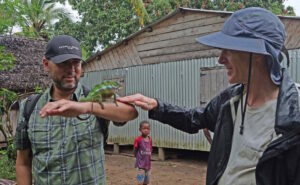
Carlos and Kevin examine a panther chameleon (Furcifer pardalis) during a visit to Ambodivohangy village. Photo: Claudia Morawetz
Perhaps foolishly given all the challenges, we built an ecolodge called the Aye-Aye Forest Camp adjacent to Farankaraina. Our hope is that once it is profitable, those profits will help fund the NGO. Ecotourism is an opportunity to contribute to the local economy through jobs and buying local goods, and it helps local people understand the value of their forest. Currently, visitor permit fees go to Fandroakando and the VOI to fund conservation and community projects.
There is so much more we want to do, and so many opportunities. Poverty means that many people are preoccupied with getting through the day and earning a living so they can eat and have a home. One of the most rewarding aspects of our time in Madagascar is getting to know the people and especially youth and children. Many people, and especially youth, are keen to conserve their forest because they recognize it as an irreplaceable treasure. We want to help more of them become leaders in their community, develop new skills, start businesses, and earn income from activities that do not require cutting down trees, killing lemurs, or eking out a living growing rice on a small piece of ever-degrading land.
Conservation is hard work and there is still so much to do, everywhere. But anything is better than nothing and no matter what you do, it can be as rewarding and fulfilling as you make it. We feel privileged to be able to contribute so tangibly to our team’s efforts on the ground. Hopefully we will see you in Madagascar some day!
Afterword: I am somewhat in awe of Kevin and Claudia for having the chutzpah to get Fandroakando NGO started, give it all kinds of assistance, and stick with it through thick and thin. (The ecolodge is also timely, needed, and superbly situated.) Biome is proud to be a part of this. – Anne Lambert, Biome founding director