Field notes: Visiting FCAT in Ecuador
 August 5, 2026
By Ana Mandri, Biome Executive Director
I’ve read the partner reports and spoken with most of the people behind them, but nothing teaches you the way a visit does, and this trip to Ecuador was no exception.
I arrived at Fundación para la Conservación de los Andes Tropicales (FCAT) after a full day of travel, crossing Ecuador from one end to the other. What I found was a landscape of contradictions. FCAT sits inside the Mache Chindul Ecological Reserve, 120,000 hectares of protected nature on paper. In reality, only 1% belongs to the government; everything else is private, so landowners do as they please, creating a forest that has been cut into fragments.
Less than 4% of it is still considered primary forest.
But countering the fragmentation is FCAT, which is stitching it back together, one patch at a time.
The restoration starts with “nuclei” (Nucleation-based restoration). In a completely deforested patch, they plant a small 15-by-15-meter cluster of tree species that attract animals that disperse seeds.This model allows the forest to start growing outward from this core.
I visited a site that’s four years old. You can still see grass, but new species carried in by birds and bats are already taking root. Then I saw one that’s seven years old, and it’s hard to believe it was ever a cattle pasture.
Alongside the nuclei, FCAT runs an agroforestry program with surrounding communities. Biome funds the salaries of the extension team: eight young people working with eighty families across a four-hundred-hectare corridor — connecting what forest remains. It is nothing short of a monumental effort. Families get Nacional cacao, a native variety of cocoa bean tree that grows under the canopy and outlives the GMO alternative the government pushes. They also receive other native and fruit trees depending on what each household wants. The team visits each family every week, checking on the trees and teaching organic practices instead of pesticides. It’s not easy work, but the seven girls and one boy who carry it out make it look easy.
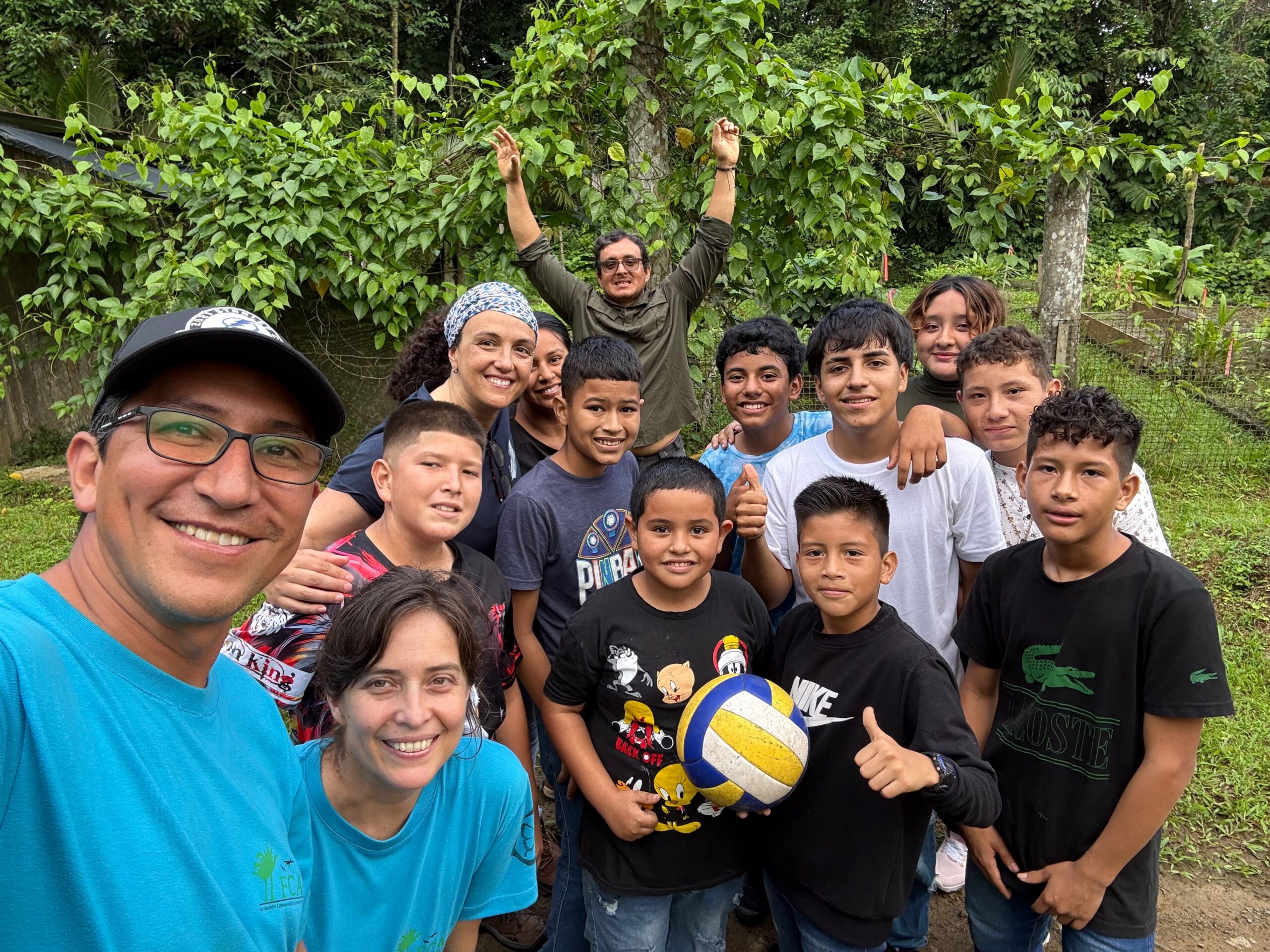
Where did they find this extraordinary group of young talent? One of them told me she still remembers, as a little girl, the environmental talks Luis used to give. Others came up through FCAT’s youth club, which Biome has funded thanks to the trust a Canadian couple placed in us and in FCAT.
The club started four years ago, though the idea is older than that. Twenty-five years ago, when Luis and his team first came here as young biologists, they built environmental education groups in these same communities. There was no road back then. Luis told me what it was like walking from one community to another through muddy trails, sinking up to your waist, where losing a boot along the way was just part of the trip. Some of those kids grew up to become fully involved in conservation. They call themselves FCATeros, the boots on the ground who make all conservation work possible.
Today’s club takes a different approach. Teenagers come to the station, where they get fully immersed in the science, the landscape, and the innovation happening around them, while playing and understanding better what their home has to offer. I spent one morning with this group, and it was an injection of energy and hope for the future.
It’s easy to see why these kids get so excited about science. There is so much happening at the station at any given time, with scientists studying everything from bats and birds to plant-animal interactions, seed dispersal, amphibian diversity, soil studies, and aquatic ecology, while camera traps and nest boxes track who moves through the forest when no one’s watching, and new species turning up more often than you’d expect. Researchers, many from universities in the US, are drawn to this place for its biodiversity, but just as much for its team. Every scientist here is paired with a FCATero, a local team member who learns the research while teaching the researcher the land and the local knowledge that only comes from growing up here.
I leave this corner of the world with my heart full, grateful, and inspired by this team. People working in one of the most fragmented landscapes I’ve ever seen, in a place still full of species we haven’t even named, doing it with professionalism and with joy. They know they are giving nature a chance to recover. They know they may never see the results of their own work. But they also know they are leaving a legacy, for the Chocó and for the entire planet.